
 .
Diffusion-Based Adaptive Channel Denoising for Deep Joint Source-Channel Coding in Semantic Communications
IEEE Transactions on Cognitive Communications and Networking, Early Access2026 Journal
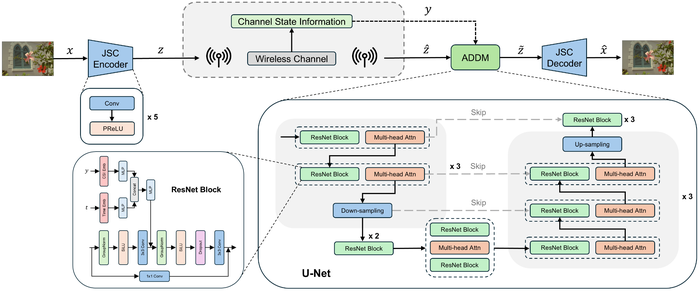
Recent advancements in deep learning have led to the emergence of deep joint source-channel coding (DeepJSCC) as a powerful technique for robust and efficient communication over noisy channels. This approach is regarded as a key enabling technology for semantic communication (SemCom), a paradigm that ensures only relevant information for the underlying tasks is transmitted at the receiver. Currently, diffusion models have demonstrated remarkable success in generative tasks, where they learn a denoising process to restore the original signal. This paper introduces an adaptive denoising diffusion model (ADDM) for DeepJSCC in SemCom, which dynamically learns the channel denoising process based on the corrupted signal and channel state information (CSI). By modifying both forward and reverse diffusion processes and integrating CSI through multi-head attention mechanisms into the U-Net model, our system tailors the diffusion trajectory to the specific noise level, leading to more efficient and accurate signal reconstruction. Extensive simulations on ADE20K and ImageNet datasets demonstrate that our adaptive approach significantly outperforms specialized, fixed-SNR DeepJSCC baselines across a wide SNR range, particularly at low signal-to-noise ratio (SNR) regimes below approximately 5 dB. Additionally, our model does not rely heavily on CSI, which is critical in scenarios where channel information is unavailable or CSI estimation is imperfect.