2026

Figure from “Diffusion-Based Adaptive Channel Denoising for Deep Joint Source-Channel Coding in Semantic Communications”

Diffusion-Based Adaptive Channel Denoising for Deep Joint Source-Channel Coding in Semantic Communications

L. V. Nguyen, H.-J. Zepernick, N.-S. Vo, H. Shin, T. Q. Duong

IEEE Transactions on Cognitive Communications and Networking2026 Journal

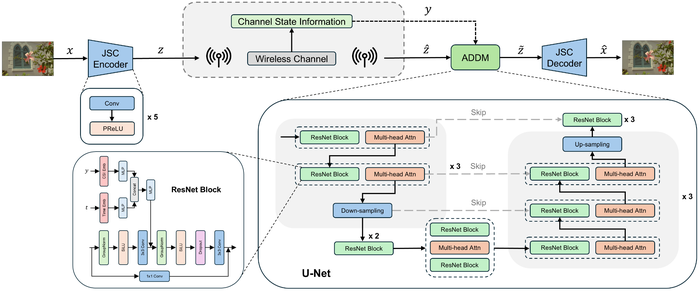
Recent advancements in deep learning have led to the emergence of deep joint source-channel coding (DeepJSCC) as a powerful technique for robust and efficient communication over noisy channels. This approach is regarded as a key enabling technology for semantic communication (SemCom), a paradigm that ensures only relevant information for the underlying tasks is transmitted at the receiver. Currently, diffusion models have demonstrated remarkable success in generative tasks, where they learn a denoising process to restore the original signal. This paper introduces an adaptive denoising diffusion model (ADDM) for DeepJSCC in SemCom, which dynamically learns the channel denoising process based on the corrupted signal and channel state information (CSI). By modifying both forward and reverse diffusion processes and integrating CSI through multi-head attention mechanisms into the U-Net model, our system tailors the diffusion trajectory to the specific noise level, leading to more efficient and accurate signal reconstruction. Extensive simulations on ADE20K and ImageNet datasets demonstrate that our adaptive approach significantly outperforms specialized, fixed-SNR DeepJSCC baselines across a wide SNR range, particularly at low signal-to-noise ratio (SNR) regimes below approximately 5 dB. Additionally, our model does not rely heavily on CSI, which is critical in scenarios where channel information is unavailable or CSI estimation is imperfect.
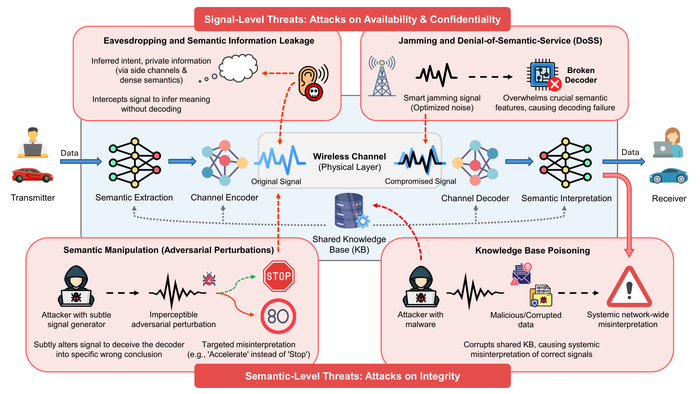
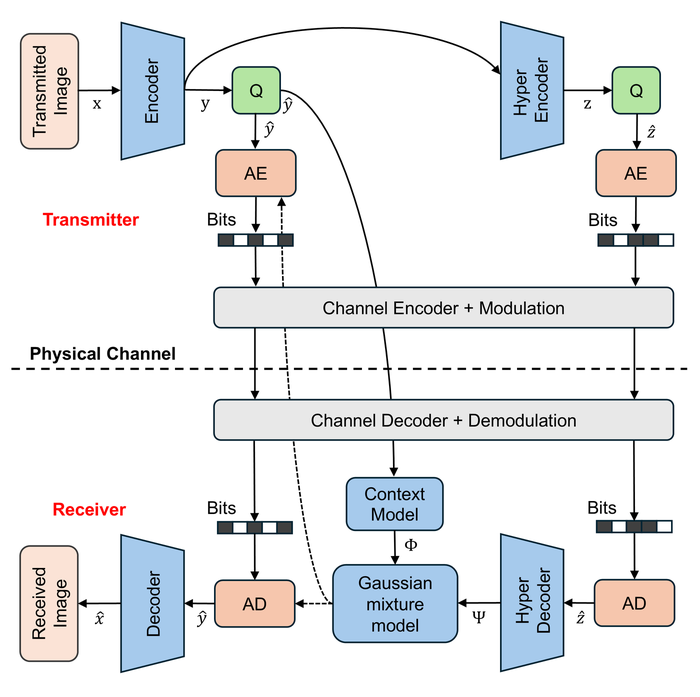
Figure from “Physical Layer Security for Semantic Communications: Challenges and GenAI-Based Strategies”

Physical Layer Security for Semantic Communications: Challenges and GenAI-Based Strategies

L. V. Nguyen, Y. Liu, Q. N. Le, T. Q. Duong

IEEE Network2026 Magazine

Semantic communication (SemCom) has emerged as a paradigm shift to revolutionize next-generation wireless networks. By transmitting only task-relevant semantic features, SemCom promises unprecedented gains in efficiency and reliability. However, this transition introduces a novel and complex security landscape, where threats extend beyond bit interception to the inference of user intent and semantic interpretation. Physical layer security (PLS) is considered an important technique for defense against these new attacks due to its foundational properties. This paper provides an overview of PLS in SemCom systems. We first explore the background of SemCom and PLS. We then delve into the current security vulnerabilities inherent to SemCom, including two main threats: signal-level threats and semantic-level threats. Subsequently, we point out potential generative artificial intelligence (GenAI)-driven strategies to counter these security issues. Through a case study, we propose a robust framework that utilizes a large language model and deep reinforcement learning to optimize PLS in SemCom. Finally, open research challenges and future directions are presented to facilitate future research development in this rapidly evolving field.

2025

Figure from “Digital Semantic Communication with Neural Image Compression”

Digital Semantic Communication with Neural Image Compression

L. V. Nguyen, T. T. Nguyen, O. A. Dobre, T. Q. Duong

IEEE International Conference on Computer Communications (INFOCOM)2025 Conference

In this work, we introduce a neural image compression-enabled semantic communication system to enhance the efficiency of digital image transmission, named NCSC. By employing an accurate and adaptable entropy model, NCSC obtains the efficiently compressed bitstreams, which are compatible with digital communication systems. Incorporating with the well-established digital components, our system trained on the MS-SSIM metric can achieve a significant bandwidth compression ratio of 0.002 at low SNR, reducing remarkably transmission overhead.

2024

Figure from “Leveraging Stable Diffusion with Context-Aware Prompts for Semantic Communication”

Leveraging Stable Diffusion with Context-Aware Prompts for Semantic Communication

L. V. Nguyen, T. T. Nguyen, O. A. Dobre, T. Q. Duong

IEEE 21st International Conference on Mobile Ad-Hoc and Smart Systems (MASS)2024 Conference

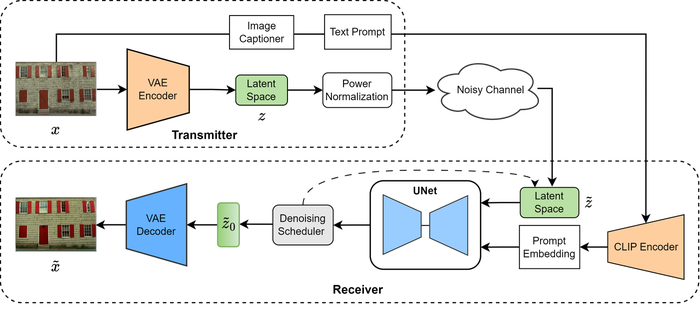
In this study, we present a novel Stable Diffusion-based semantic communication (SDSC) framework that demonstrates high performance, characterized by an elevated bandwidth compression ratio (BCR) and robust noise tolerance achieved by diffusion mechanism integrating supplementary prompts. This scheme significantly enhances the system's ability to preserve data integrity and meaning in noisy environments. By introducing additional context-aware prompts during transmission, we improve the accuracy of received information and mitigate the adverse effects of interference and noise.